Live Poor & Die Rich - or Live Rich & Die Poor
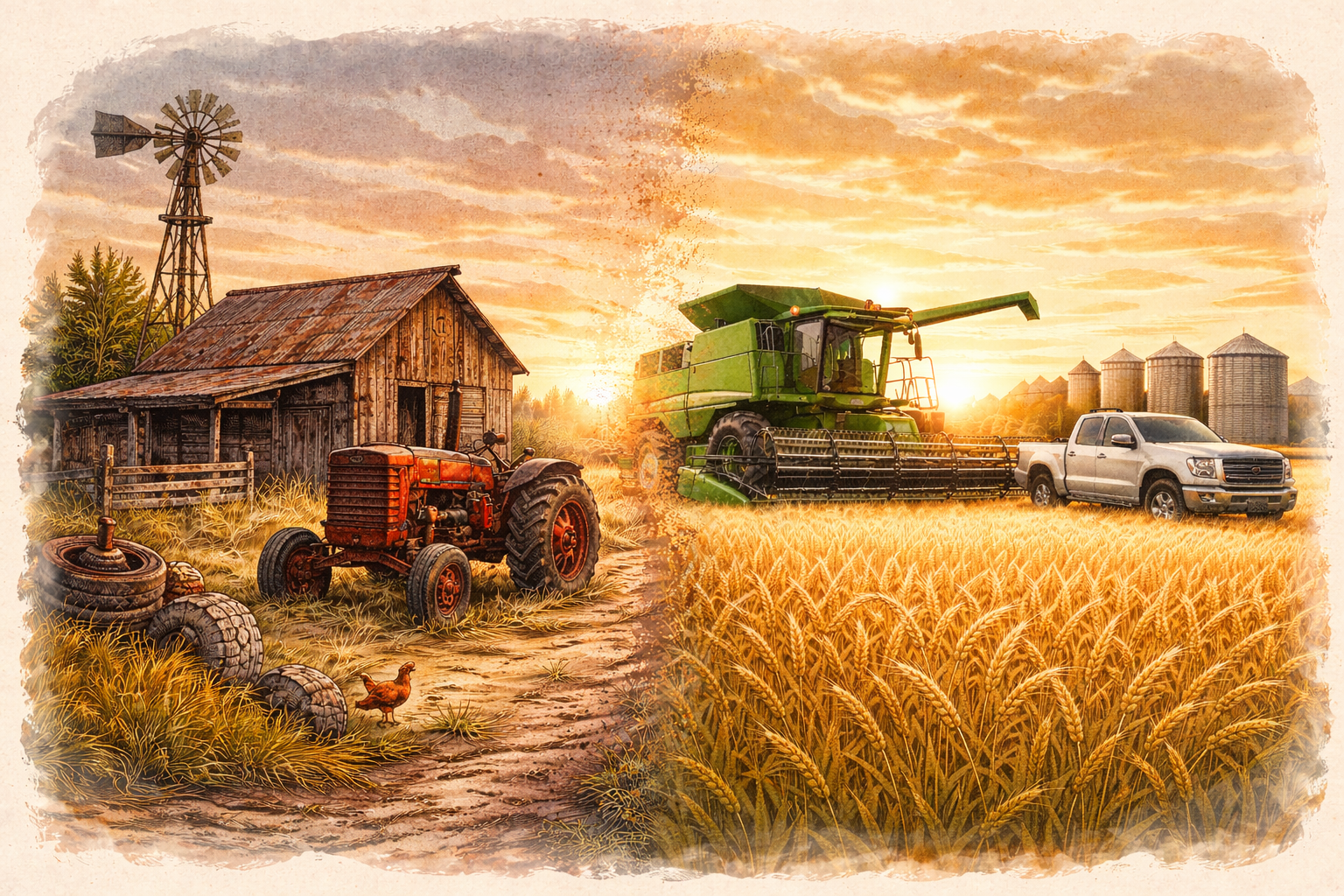
There’s an old saying around where I grew up, that farmers “live poor and die rich”. I was reminded of the truth of it this Christmas, when Jill and I and Sara (our exchange student from Italy this past semester) journeyed to North Dakota for what would be Sara’s last big trip before heading home to Italy days later.
Times are tight for farmers across the country - which in our home region means times are tight for everyone. Tractor and combine inventory is stacked up high, and prices are coming back down on second-hand equipment - because no one is buying. This means the tractor and combine salespeople aren’t buying new pickups or big screen TV’s, and eventually that the wait staff at local restaurants are getting fewer shifts, and the tip pools are smaller.
The interesting twist is that yields were strong, and though prices have been much higher they aren’t at historic lows. But the input costs have been soaring, and so farmers need a lot of revenue just to pay the costs of putting the seeds and fertilizer in the ground. Labor costs are high too - our family farm has been importing South African labor for years, and has a new guy starting in March.
I’m gonna dig into some macroeconomics in this month’s blog, starting with the key factors of our latest farm crisis, and digging into the microeconomic truth and value of saving and investing, and the aggregation of all those small decisions.
So - “What are the key factors in our current farm crisis?” you say - and I’m going to sound like a broken record - but it starts with the global response to the Covid virus. Shutdowns, lockdowns, essential business only, supply chain mayhem, port backlogs - all of that stuff is sand in the gearbox of creating and delivering food to people. But it turns out, not nearly enough people died to materially affect the demand curve, and so crop prices spiked across all commodities in the 2021-2022 timespan. Additional factors included the Russia-Ukraine conflict - Ukraine is a major breadbasket region - and China being a big importer of corn and soybeans due to their own bad weather and a desire to rebuild hog stocks.
Input costs were high, due to high oil and gas prices (natural gas is what they make nitrogen fertilizer from - if you didn’t know), and labor shortages (anyone remember funemployment?) but farmers could make a buck due to the high crop prices. And they’d need it - because all the funny money printed around the world created a lot of demand for farm equipment (and cars and whatnot else), and the prices of those items soared up 30%+ for many items in that period. Farmers could work to find leverage on rising costs by scaling - and leverage they did, financing land purchases at historic highs, often with 3 - 5 year fixed bank loans.
But now - we can blame China again - or blame Trump if that’s your preference - because China quit buying American soybeans as part of ongoing trade disputes. In November of 2025, the US and China (maybe?) made a deal to move some beans and reduce some tariffs and open markets on rare earth elements and more in 2026, but the purchases have been below pledges so far, and there doesn’t appear to be a signed deal in hand.
And now, with the capture and indictment of Venezuela’s President Maduro, there are some additional pressures that figure into the equation. China was the destination for 7 out of 12 barrels of oil coming out of Venezuela, used to repay debt China has extended over the last decade or two. Venezuela is the poster child for the second part of my blog title this week - live rich and die poor.
It’s more complicated than this, but my big picture on Venezuela is that Maduro’s predecessor, Hugo Chavez, was rolling in dough due to high oil prices and put expansive social programs in place. Also, he put his buddies in charge of the national oil industry - but they were political people, not oil people - and then oil prices went down - and then, everything went down.
Once a thriving agricultural production hub of South America, Venezuela has been rocked by corruption, inflation, and sanctions - and has had a steady drop in GDP from over $13K per person in 2010, down to below $2K per person in 2020, and back up to over $4K by 2024. That’s per person, per year. It's misery in Venezuela lately and that’s why all the smart people and gang bangers moved to the US during the open border years.
And, sadly - we’ve been following their lead, overspending our revenues as a nation by as much as ⅓ of the budget in recent years, and making up the difference by printing more debt. I’ve written plenty about that problem in recent months and years though, so back to the farmers.
One of the reasons farmers “live poor and die rich” is that they must be prepared for the years when they don’t make much profit - as recently. If they spend all their profits in the good years, that means they’d have to take on debt in the bad years, but then if there’s two or three bad years in a row, or four out of five - then there’s a farm auction, as the bank can’t always wait for times to get better.
Most farmers don’t have a Plan B, so they work hard and live poor to ensure the farm can survive these low times - and so that there’s a farm to pass on to the children. Farming is a business, but even more than most businesses - it’s a legacy. I’m so glad that my youngest brother has been actively involved in the farm for decades now, and is well positioned to take over farm operations when dad retires - or more likely - dies in the tractor seat. He’s a super-healthy 71 today, and I think we’ll get another 20 years from him, which gives time for my nieces and nephews to grow up and start families of their own - one of which I hope will become heir apparent to the farm someday.
Historically, it wasn’t just the farmers who lived this kind of - “for the next generation” mentality. People have built wealth through businesses and real estate and savings through good ol’ stocks like IBM and GE and such for generations, and often with the desire to pass some of that along to give their children more opportunities than they had. But nowaday most of the financial assets are held in 401K’s and IRA’s - retirement accounts - and the prevailing wisdom appears to be getting enough in those accounts to sustain or increase income level in retirement from the working years, and to get the pile mostly spent by the time we die.
And why not? The kids live half-way across the country, and we only see the one grandchild twice a year for a few days, and who wants to live for the next generation when my time is now!
As most of my readers know, Jill and I have no children of our own, and also know that we’ve hosted many international youth exchange students. Sara Armanni was the most recent, and we can’t wait to go see her and her family in Italy - maybe in 2027. We lived rich while she was staying with us, with extra restaurants and concerts and a 9 day Colorado-Utah camping tour, and a trip to Mexico and California. And so now we’ve got to live poor for a while, and save up for the next kiddo from somewhere - so we can live rich again when that time comes.
So I write this blog with no judgement on those who live rich - I’m one of them, at least during seasons of life - but also I see our culture probably too heavily swayed to that side, and at least in part because there’s less thought about the next generation. Our birth rate in the US has been dropping steadily since the “baby boom” of the late 40’s and 50’s - as high as 3.62 babies per woman in 1960 - and down to 1.62 for 2023 - and up a tick to 1.79 for 2024 and 2025.
This means that there are very few households with 3 or more kids these days, and many with one or zero children. When I was growing up, the notion of “Oh wow, you got a lot of kids” was hit at the 8 or 10 mark, and today I’d say that number is 4. Today 1 or 2 kids is normal, 3 is a little weird, and 4 is whackadoo, and probably some kind of fundamentalist Christian family, or LDS - or Hispanic.
I think as with everything, culture starts at the family level, and it feels to me like this “live rich today" culture ties back to the lack of next generation thinking which is tied to the lack of children in families.
“But kids are so expensive these days” is what many of my readers are saying - and it’s true - but they’ll make you rich. What is there of higher value than family? Because if we’re working and living focused on the next generation, we’ll make better long-term decisions - which aggregated will create a stronger, happier, and healthier nation over time.
Thanks for going along on that squirrel chase! - in summary: Seize the day, save for tomorrow, find love and make babies.